They brought us out to the main floor, Costa's hand on my elbow, and I saw the machines first, huge dead presses under hanging lights, and then I saw Nick standing alone in the middle of the concrete with a flash drive in his hand. He had no men. No coat. He looked at Lucy and me and let out a breath I could see.
“Marisol,” he said. “Are you hurt?” I said we were okay. Lucy said his name so loudly it echoed off the presses, and the silver-haired man, Gino Ferrante, raised his eyebrows at it. “She trusts you already?” he said, and I saw it annoy Nick more than it should have.
They bargained like old men who had done it before. Ferrante wanted the drive first. Nick wanted us to walk first. Ferrante said Nick still negotiated like he was twenty-five and Nick said Ferrante still talked too much. I stood with my arms around my daughter and watched two men who had once been brothers measure each other across thirty years.
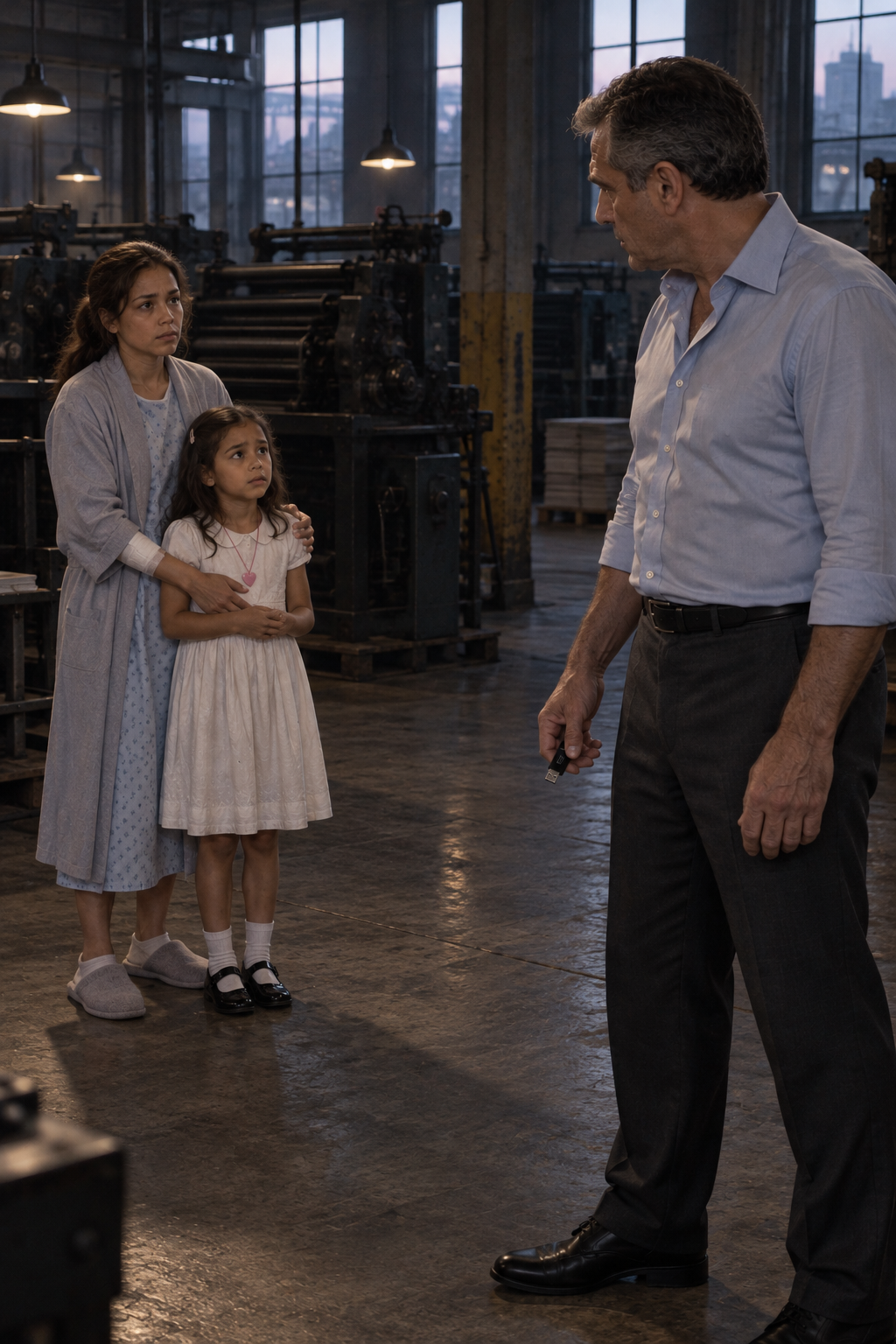
“Carla would barely recognize you,” Ferrante said. Nick told him he didn't get to say her name. Ferrante said she'd wanted Nick out. She hated what he was becoming. She had come to him, Ferrante said, and I watched Nick take one step forward before he stopped himself. I understood then that the taunt was the point. Ferrante wanted him angry. Angry men make mistakes.
Nick said, “You ordered her intercepted,” and Ferrante said he had only ordered Albert to scare her, that it was never supposed to happen. “But it did,” Nick said. Ferrante shrugged. He said Nick had built an empire afterward. Maybe tragedy had made him useful. I was watching Nick's face, and I expected rage. What crossed it instead was something close to disgust, the way a man looks at the thing he has feared for years once he finally sees it up close, small and old and pleased with itself.
“You know the problem with surviving this long, Gino?” Nick said. “You start assuming everyone else wants to live the way you do.” He dropped the flash drive and put his heel on it. I heard it crack. Costa shouted. Ferrante's face came apart. Nick said, evenly, that copies existed and would be with federal investigators before morning, and that he'd already done what Ferrante said he wouldn't.
“You'll destroy yourself,” Ferrante said, and Nick said probably. “Thirty years!” Ferrante shouted, and the composure he'd worn all night cracked. “You spent thirty years building your name!” Nick pointed at my daughter. He said Ferrante still didn't understand why a seven-year-old had walked into his restaurant. She hadn't come looking for a criminal empire. She had come looking for someone powerful enough to say no. He had spent his life believing power meant people being afraid of him. “Turns out that's the cheapest kind.”
Ferrante pulled a gun. I put my body over Lucy's. Nick didn't move, and I remember being furious at him for not moving, and I remember Ferrante's voice. “You'll die with your new philosophy,” Ferrante said. “No,” Nick said. Lights swept across the high windows, blue and red, and voices came through the doors shouting commands.
Nick came at us like a man throwing himself off a roof, and the three of us went down behind an iron pillar with his back covering my daughter. I heard Costa drop to the floor. I heard shouts and a scuffle by the side exit where Ferrante ran and didn't get far. Nick stayed over Lucy until the shouting stopped. Then he moved slowly away, and asked her if she was okay, and she nodded.
Lucy threw both arms around him. I watched his hands hover as if he didn't know where hands went, and then one settled on her back. “You came,” she said. “I promised,” he said. “You really came.” He closed his eyes.
“You came alone,” I said. “Yes.” “That was incredibly stupid.” “You're welcome,” he said, and for a second I almost laughed in a room that had nearly killed us both. I gave him a long look. It was not forgiveness. It was the look you give someone who has just done a stupid and necessary thing.
I learned how the police arrived afterward, because I asked, and because I did not believe in rescue that was only luck. In the small hours, after reading Albert's statement, Nick had called his lawyer, Ruth Abelman, who reached Agent Whitcomb at home. The federal agents knew about the files before the kidnapping. When the text arrived, Joey called Whitcomb with the address Nick had been given, and Cleveland police and FBI staged a few blocks away. Nick had asked Joey to wait until he'd been inside ten minutes, long enough to see us and to keep Ferrante from panicking. Nick himself had not known whether they would come in time. He walked in anyway.
I was taken to a different hospital, not by choice but by insistence, and I would not let anyone persuade me that the first one had been unlucky. The unlucky part had been trusting one guard and a nurse. Pete Genaro recovered. Ray Costa began cooperating before breakfast. Gino Ferrante was held on charges including kidnapping, and the files Mateo had scanned began opening investigations into decades of financial misconduct, coercion and corruption connected to Ferrante's people and, uncomfortably, to Nick's.
Agent Whitcomb came to my bedside with a notepad. She told me the drive's contents were leads, that the transfer records had to be traced through actual banks, that Albert Rinaldi's statement could not be cross-examined, and that she did not want me to expect a tidy answer about Carla Bruno. I said I'd learned not to expect tidy answers. She said, “Good, because the people who expect them make the worst witnesses.”
Three days later Lucy and I moved into a furnished apartment arranged through the victim-witness office, with two agents posted downstairs. Nick came once. He brought one of his men and I told him at the door that he could not keep arriving with security. He said people were still looking for those records. I said there were three federal agents in the lobby. He said they were amateurs. I said one of them was sixty. “Experienced amateur,” he said, and I sighed, and Lucy came running.
He handed her a paper bag and I said no before I knew what was in it. “If it's expensive, no.” “You don't know what's inside,” he said. It was a stuffed lion. Lucy had told him she liked lions, and when I started to object she said, “I said they're brave.” “Exactly,” said Nick, and I told him he was encouraging her. “Probably,” he said, as Lucy ran to show the thing to the agents.
I lowered my voice. “You risked your life.” “So did she.” “She's seven.” “Which makes her braver than most adults I know.” I asked him again why us, and he looked at Lucy and said that thirty years ago someone needed him to be better than he was, and he wasn't. “You couldn't save her,” I said. “I helped build the world that killed her.” I told him that didn't mean he had to spend the rest of his life dying too. I also told him, because I'd been turning it over for three days, that none of this meant I owed him anything. He nodded as though he'd expected the sentence and respected it.
That afternoon Lucy shouted from the living room. The television was showing police escorting a thin man in a wrinkled jacket out of a downtown building. My brother had been found alive. He had been hiding in a friend's basement in Akron, trying for weeks to reach a federal tip line without telling the wrong person, and the wrong person had been everywhere.
We drove to the federal building. I saw Mateo through the glass and I ran. He stood when I came in, and I held my brother and felt his bones, and Lucy wrapped herself around both of us. Nick stayed by the door. Mateo finally looked over. “Nick Valenti?” he said. “I guess I owe you.” Nick looked at me and said no. Mateo followed his eyes to Lucy, and I saw understanding cross his face. “Maybe you owe her,” I said, quietly.
Mateo handed over the metal case with the paper originals, and the agents were pleased. They were also quiet about one thing. Some of the old transactions pointed toward companies Nick still controlled. The archive was a beginning, not a charge sheet. Ruth Abelman later explained to me that discovering old papers did not restart a prosecution deadline. Over the following weeks, investigators obtained newer records and testimony about a scheme that had continued into March 2024: false business books and coordinated filings intended to obstruct the IRS from assessing taxes. Nick admitted his own part in that recent conduct. That first evening he did not have a signed deal to accept. He told Ruth to begin cooperation discussions and to stop protecting his reputation at the expense of the truth.
I learned of it from Joey, who called me that evening with the tone of a man betraying a confidence for the right reason. “He hasn't told Lucy,” he said. “He's going to turn himself in. He's going to leave her a note.” I put the phone down and went to find him.
I found him alone in the empty Silver Anchor after closing, at the corner table, with a glass of water nobody had drunk. “You're surrendering,” I said. “Yes.” “Why didn't you tell Lucy?” “Because she's seven.” “She thinks you're coming tomorrow for ice cream. She made a drawing.” He said he didn't know how to tell her. I watched a man who had walked into a warehouse and faced the person who ruined his life sit before me, afraid of a second grader.
“You do not get to teach my daughter that promises matter,” I said, “and then disappear without saying goodbye.” “I don't want her to remember me as a criminal.” “She'll remember the man who came when she asked for help. That doesn't erase the rest. But maybe what you do next matters too.” I told him three o'clock, and that he would tell her himself. He looked at the chair beside him, the one my daughter had grabbed his sleeve beside, and said yes.